Best Lightweight Travel Strollers for Flying (2026): 3 Models Compared for Real Airport Use
As an Amazon Associate I earn from qualifying purchases. Prices and availability are accurate as of the date/time indicated and are subject to change.
The short answer
If you only want one recommendation: Graco Ready2Jet Compact Stroller with Automatic Fold. For most families flying with a toddler, the Graco Ready2Jet is the correct pick: overhead-bin compatible on major US carriers, automatic fold means one hand while holding the kid, and Graco has real US customer service if a wheel breaks mid-trip. Buy this unless you specifically need under-10-lbs total weight (then look at gb Pockit).
Check price on Amazon →🔍 How this guide was put together (Editorial Standards)
This guide compares options using published manufacturer specifications, patterns in publicly visible owner reviews, and reputable expert sources. We do not operate a physical testing lab; see our how-we-research page for details.
EDITOR'S PICKS
Top Picks
TOP PICK

Graco Ready2Jet Compact Stroller, Overhead-Bin Friendly, Automatic Fold
Best all-around for US-carrier flights — overhead-bin compatible + automatic fold + established brand support.
RUNNER-UP

Beberoad Love R2 Travel Stroller for Airplane
Best if regional/budget carriers are your reality — explicitly marketed for airline travel with smaller folded dimensions than most 'travel' strollers.
BEST VALUE

Mompush Lithe V2 Lightweight Travel Stroller with Snack Tray
Best for long airport waits and gate delays — snack tray included, which sounds trivial until you're stuck at a gate for 3 hours with a hungry toddler.
📑 Table of contents
- Overhead-bin compatible ≠ lightweight — the distinction that saves you a gate-check
- Automatic vs. manual fold — one-handed reality
- Under-seat vs. overhead-bin storage — different games
- Who should buy which — decision framework
- What airlines actually let you do at the gate — 2026 update
- Common first-year mistakes with travel strollers
- Comparison
- Related guides
“Travel stroller” is one of the most misleading product categories in baby gear. Manufacturers apply the label to anything sub-15-pounds, but the ACTUAL variables that matter for flying — overhead-bin dimensions, gate-check queue speed, one-handed fold reliability, and how well the stroller survives baggage handlers — vary enormously between models with similar spec-sheet weights.
Below, we cover what actually matters at the airport (based on how flights work in 2026), then three recurring picks that each solve different travel patterns.
Overhead-bin compatible ≠ lightweight — the distinction that saves you a gate-check
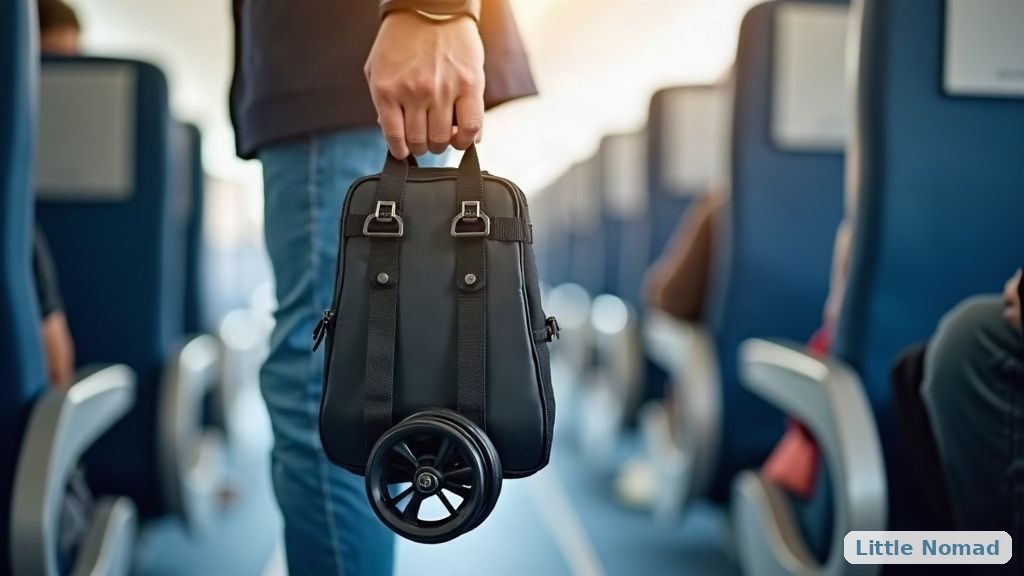
Airlines have different overhead-bin dimensions:
- US majors (Delta, United, American Main Cabin, Southwest): ~22-24” long × 14” wide × 9” deep. Most compact strollers fold to fit — but you need to verify per airline and per aircraft type. A Boeing 737 has different bin size than a 787.
- US regional / basic economy overhead: often smaller. A “fits in bin” stroller on a mainline flight may need gate-check on a Delta Connection E-175.
- International budget (Ryanair, Wizz, Spirit, Frontier basic): even tighter. Some airlines have specific pre-departure size checkers at the gate.
A stroller marketed as “overhead-bin compatible” (like the Graco Ready2Jet) has typically been tested on major US carriers. It’s not a guarantee across all airlines. Before flying:
- Check your specific airline’s stroller policy page
- Check overhead-bin dimensions for your specific flight’s aircraft type (SeatGuru or airline app)
- Measure your stroller folded, using the actual folded dimension including handle position, not the marketing “compact folded” spec
Weight is a secondary variable. A 12-lb stroller that gate-checks because it doesn’t fold small enough costs you gate-check time (~5-10 minutes per boarding) and cargo-handling risk (broken wheels, torn fabric). A 14-lb stroller that fits in the overhead bin skips all of that.
Automatic vs. manual fold — one-handed reality
The Graco Ready2Jet has automatic fold (a button that engages a spring-loaded fold mechanism). The Beberoad and Mompush have manual multi-step folds. This distinction matters more at the airport than most first-time buyers weigh it.
Boarding a plane with a toddler is rarely a two-handed activity:
- One hand holds the child (or the child’s hand)
- One hand carries a diaper bag, a snack, a phone with boarding pass, or the child’s shoes
- Behind you, 30 people are waiting to board
An automatic-fold stroller requires ONE hand + ONE button press + ONE motion to collapse. A manual-fold stroller requires TWO hands + a specific sequence (unlock, push down, lock). If you get it wrong (which happens under boarding stress), the stroller half-opens back up mid-jetway.
Under-seat vs. overhead-bin storage — different games
Some airlines (especially in Europe/Asia) allow strollers under the seat in front of you if they fit. Under-seat dimensions are much smaller than overhead bins: typically 18” × 14” × 9”. Very few strollers actually fit — most that claim to (gb Pockit series, some ultralight European brands) fold to ~11-12” and have no rigid frame.
The three picks above are overhead-bin candidates, not under-seat candidates. If you specifically want under-seat capability (rare, but useful on some transatlantic budget carriers), you’re looking at a different product category entirely.
Who should buy which — decision framework
Buy the Graco Ready2Jet if:
- You fly primarily US majors (Delta, United, American, Southwest)
- Automatic fold matters — you’ll be handling the stroller one-handed while managing a toddler
- Brand support matters — Graco has US-based customer service and easy replacement parts
- The stroller will double as your everyday outdoor stroller when not traveling
Buy the Beberoad Love R2 if:
- Your typical trip involves regional carriers or international budget airlines with tighter bin sizes
- You prioritize the smallest possible folded footprint over automatic fold
- The stroller is primarily a TRAVEL stroller, not your everyday-outdoor stroller
Buy the Mompush Lithe V2 if:
- Long airport waits are common for your travel pattern (frequent connecting flights, international transits, gate delays)
- The snack tray add-on solves a real problem for you (yes, this sounds trivial — parents of picky toddlers know it isn’t)
- You’ve flown enough to know that the difference between a manageable travel day and a meltdown day is often just “did I have somewhere to put a cheese stick”
What airlines actually let you do at the gate — 2026 update
Gate-checking: Most US airlines let you bring the stroller all the way to the jetway, then hand it to the crew, and pick it up jet-side at your destination. Standard for larger strollers. Free.
Overhead-bin carry-on: Free on most airlines if it fits without displacing another passenger’s normal carry-on allocation.
Traveling as checked baggage: Standard-size strollers travel free as checked items even on budget airlines (US), but subject to normal cargo handling risk. Not recommended for anything you don’t want dropped/broken.
Restrictions: Some basic-economy fares (Delta Basic, United Basic Economy) have stricter overhead-bin rules for gate-check strollers vs. regular passengers. Verify your fare class allows overhead-bin stroller carry-on.
Common first-year mistakes with travel strollers
-
Not folding once before the trip — some strollers require unlocking mechanisms that take practice. The airport jetway is not where you want to learn. Fold and unfold your stroller 5-10 times at home first.
-
Underestimating tire diameter for real airports — travel strollers optimize for compact fold, so tires are usually 5-7 inches. This is fine for airport terminal floors but rough on airport curbs, cobblestones, or older jetways. Don’t buy a travel-only stroller expecting it to work on cobblestone streets in Europe.
-
Overpacking the underseat basket — most travel strollers have small underseat storage rated 5-10 lbs. Overloading tips the stroller backward when the toddler climbs out. Use the stroller for the child + boarding pass + snacks. Anything heavier goes in the diaper bag on your shoulder.
-
Forgetting the stroller manual on the plane — different models have different fold mechanisms. If the crew asks you to fold it faster during boarding and you’ve forgotten the sequence, it’s genuinely stressful. Keep the fold-instruction card in the stroller pouch.
Comparison
| Model | Fold | Bin-compatible | Notable feature | Best fit |
|---|---|---|---|---|
| Graco Ready2Jet | Automatic | Yes (US majors) | Established brand | Most families, US flights |
| Beberoad Love R2 | Manual | Compact fold | Marketed airline-first | Regional/budget carriers |
| Mompush Lithe V2 | Manual | Standard | Snack tray included | Long airport wait travel |
📚 Related In-Depth Analysis
- Compare findings with our guide on Road Trip With A Baby Checklist.
- Compare findings with our guide on Car Seat Travel System Basics.
📚 Related In-Depth Analysis
- Compare findings with our guide on Baby Travel Diaper Bag Packing List.
- Compare findings with our guide on Car Seat On A Plane.
🔧 Interactive Planning Tool
Need exact measurements for your setup? Use our Airline Cabin Stroller Overhead Sizing Matrix to Verify folded dimensions against strict IATA overhead cabin luggage limits.
Related guides
- Car seat travel systems for traveling families