Airport Security With a Baby: Rules That Speed You Up (2026)
As an Amazon Associate I earn from qualifying purchases. Prices and availability are accurate as of the date/time indicated and are subject to change.
🔍 How this guide was put together (Editorial Standards)
This guide compares options using published manufacturer specifications, patterns in publicly visible owner reviews, and reputable expert sources. We do not operate a physical testing lab; see our how-we-research page for details.
EDITOR'S PICKS
Top Picks


📑 Table of contents
The security line is where family travel days most reliably go sideways. Everyone else is already through and you’re trying to fold a stroller with one hand while a screener asks about the yogurt pouch and the baby starts to cry. It doesn’t have to be that way. Rules around traveling with a baby are actually more relaxed than for adult passengers, and knowing the specifics in advance is the difference between a two-minute pass and a fifteen-minute scramble. Rules vary by country and change — this covers the big picture in the US and common international norms, but always check your airport’s current rules before flying.
What’s different when a baby is with you
Broadly, security screens for the same threats, but the rules typically ease up for infants. The specifics below reflect common US TSA norms and similar policies in many other airports — rules vary by country and change; always confirm with your airport/airline before travel day. In general:
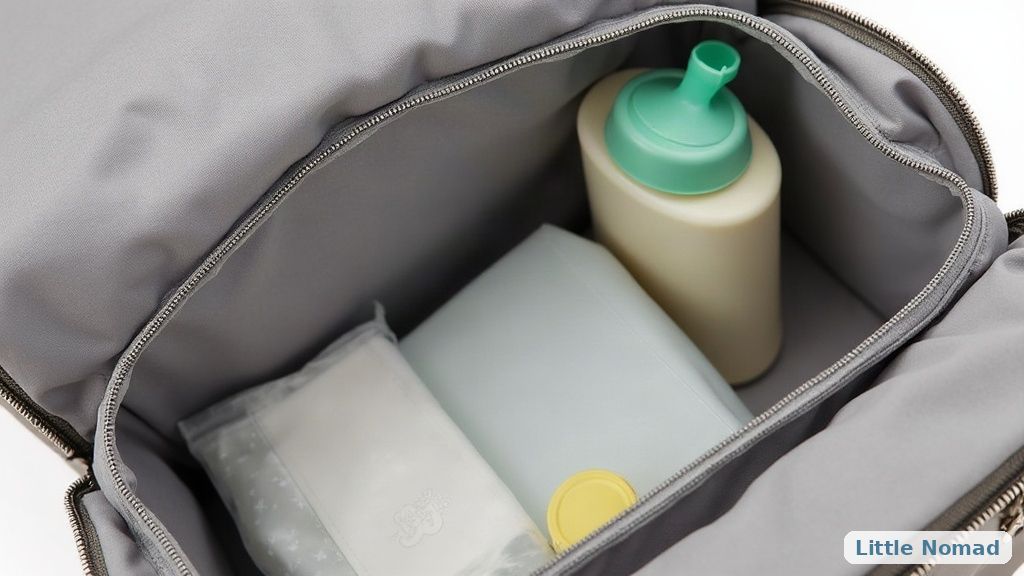
- Liquids for babies (formula, breast milk, expressed milk, water for mixing, juice for a child) are often exempt from the usual liquid limits when in reasonable quantities. Declare them at the start of screening.
- Baby food and gel/ice packs to keep milk cold are commonly allowed in reasonable amounts.
- The baby stays with you or in a carrier through screening — you don’t put a baby on the belt.
Before you get in line
| Do this early | Why |
|---|---|
| Have all baby liquids in an easy-access pocket | Officer pulls them out for extra screening |
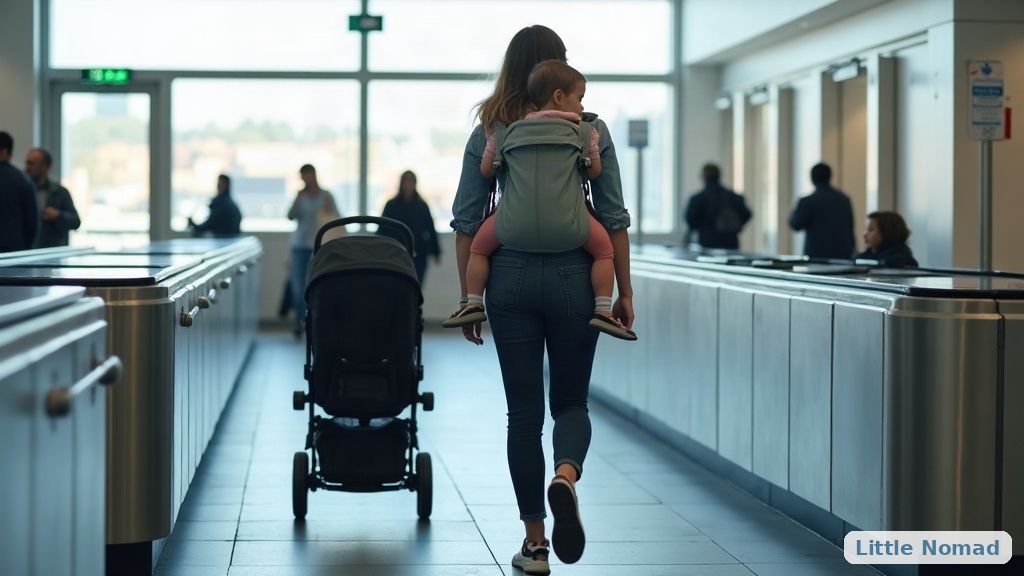
| Wear the baby in a soft carrier | Free hands for bags and stroller |
| Check airline's stroller/car seat policy at the gate | Different from security's rules |
| Empty your pockets before joining the line, not at the belt | The pocket dump costs the most time |
| Fold-test the stroller once before flying | Learning at security = the classic disaster |
At the checkpoint
- Declare baby liquids as you approach: “I have breast milk / formula / infant water.” They’ll screen them separately (sometimes with a spectrometer, sometimes visually) — this is normal, not a problem.
- Stroller and car seat go on the belt (folded stroller) or through the X-ray. Big strollers may be hand-inspected instead.
- Baby carrier — in many airports (including US TSA) it can stay on for the walk-through metal detector; others ask you to remove it. Follow the officer’s cue at the checkpoint.
- Shoes — kids under 12 in the US typically keep their shoes on; adults usually don’t unless enrolled in an expedited program like TSA PreCheck. Non-US airports set their own rules — verify locally.
The tricks that speed things up
- Family line, if available. Some airports have a dedicated family/priority lane — ask when you enter the security area.
- Split-parent flow with two adults. One goes through first with the empty stroller; the other hands off the baby (still in the carrier) once the belt is loaded. Halves the fumbling.
- A gate-check tag on the stroller before the line (get it at check-in) means you walk the folded stroller right to the gate afterward — one fewer thing to worry about.
- Expedited programs (in the US, TSA PreCheck / Global Entry — other countries have similar programs). Children can often use a parent’s benefit, but eligibility rules and age limits differ by program and by country. Confirm your program’s specifics.
For picking a stroller that folds fast enough to make all of this easier, our lightweight travel stroller guide and gate-check vs carry-on stroller guide cover the shortlist.
Do I have to taste baby food or formula at security?
You may be asked to pour a small amount into a separate container for testing, or the officer may test the container itself. In most cases you won’t have to taste it. If the request feels unreasonable, politely ask for a supervisor — you have the right to decline testing methods you’re uncomfortable with, at the cost of possibly not bringing that item through.
What if my baby is asleep and I don’t want to wake them?
Tell the officer. They can often screen the carrier without removing the baby (a hand-wand check) in the US and many other airports. Not guaranteed, but usually granted.
📚 Related In-Depth Analysis
- Compare findings with our guide on Airplane Bassinet Bulkhead Seats.
- Compare findings with our guide on Travel Stroller For Tall Parents.
📚 Related In-Depth Analysis
- Compare findings with our guide on Gate Check Vs Carry On Stroller.
- Compare findings with our guide on Car Seat On A Plane.
🔧 Interactive Planning Tool
Need exact measurements for your setup? Use our Airline Cabin Stroller Overhead Sizing Matrix to Verify folded dimensions against strict IATA overhead cabin luggage limits.
The bottom line
Airport security with a baby is more forgiving than with an adult — liquids are exempt in reasonable amounts, kids under 12 keep shoes on, and carriers usually stay on — but only if you’re prepared. Have the liquids ready to declare, fold-test the stroller before you fly, use family lanes when available, and take the split-parent flow if you have two adults. The whole thing is a two-minute pass instead of a fifteen-minute scramble. Rules do vary by country and change — check your specific airport before travel day. ecific airport before travel day. o vary by country and change — check your specific airport before travel day. o vary by country and change — check your specific airport before travel day.